

GLP-1 and GLP-1/GIP Metabolic Transformation.
Advanced GLP-1 and GLP-1/GIP therapy for eligible patients, supported by diagnostics, digital twin monitoring, body composition tracking, muscle preservation, and specialist medical oversight.
More than weight. More than a script.
GLP-1 and GLP-1/GIP therapies are among the most powerful advances in modern metabolic medicine. For the right person, incretin-based therapy can transform far more than weight — influencing appetite regulation, visceral fat, glycaemic control, insulin biology, cardiometabolic risk, mobility, sleep, confidence, and long-term health trajectory.
But too often, these therapies are reduced to a quick online prescription.
VITALIS is different.
We provide a medically governed metabolic transformation pathway that surrounds therapy with baseline diagnostics, body composition tracking, wearable monitoring, digital twin insights, nutrition and resistance training support, dose review, side-effect management, muscle preservation, and specialist escalation where needed.
This is not a script. This is whole-body metabolic transformation.
Who it is for
- · Visceral adiposity
- · Insulin resistance
- · Prediabetes
- · Elevated cardiovascular risk
- · Hypertension
- · Dyslipidaemia
- · Fatty liver / MASLD risk
- · Weight-related health concerns
- · Already on GLP-1 or tirzepatide — needing genuine monitoring
Therapy selection depends on medical review. Response varies. Medication choice depends on availability, indication, tolerance, contraindications, and clinical assessment.
The category is evolving. Most prescribers haven't.
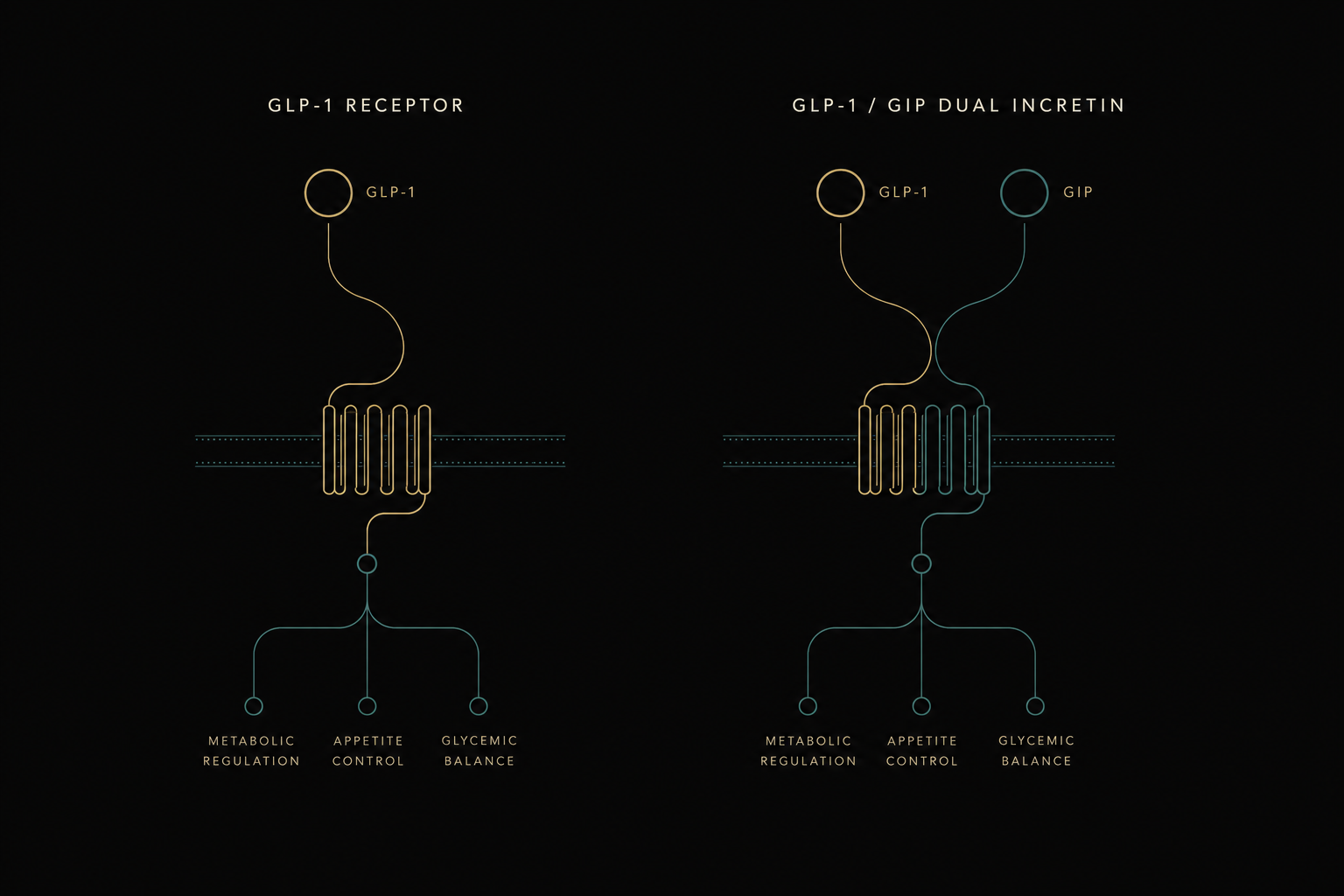
Most people search for “GLP-1 therapy”, but modern metabolic medicine is already evolving beyond GLP-1 alone. Newer therapies may also target GIP pathways, creating dual incretin effects that can influence appetite regulation, insulin biology, weight, visceral fat, and cardiometabolic risk.
VITALIS helps eligible patients understand the difference between GLP-1 therapy, GLP-1/GIP therapy, and broader incretin-based metabolic medicine — and ensures treatment is selected, monitored, and adjusted in clinical context.
This is where domain expertise matters. The question is not simply “Can I get a script?”The better question is: “Which therapy, for which biology, at what dose, with what monitoring, and what long-term plan?”
GLP-1 receptor agonism
GLP-1-based therapy may support appetite regulation, satiety, glycaemic control, weight reduction, and cardiometabolic improvement in eligible patients.
GLP-1/GIP dual incretin therapy
Next-generation therapies such as tirzepatide act across GLP-1 and GIP pathways. For some patients, dual incretin therapy may offer a more powerful metabolic effect, requiring careful medical selection, monitoring, and dose optimisation.
Precision therapy selection
VITALIS reviews medical history, goals, risk profile, side-effect tolerance, biomarkers, body composition, and treatment response to support the most appropriate therapy pathway.
Six principles that separate transformation from prescription.
The medication class matters.
The patient biology matters.
The dose and tolerance matter.
Muscle preservation matters.
The long-term maintenance strategy matters.
Monitoring determines whether transformation is safe, durable, and optimised.
“The future of metabolic medicine is not simply access to GLP-1. It is precision selection and monitoring of incretin-based therapy — GLP-1, GLP-1/GIP, and future next-generation agents — inside a medically governed whole-body optimisation system.”
One molecule. Many systems. One monitoring plan.
Incretin-based therapies — semaglutide, and increasingly tirzepatide with its dual GLP-1 and GIP agonism — act across organs and tissues. We monitor what these molecules actually do, across heart, body and brain.
Cardiovascular risk, monitored over time.
- · Visceral fat & ApoB reduction
- · Blood pressure trajectory
- · hs-CRP & inflammatory load
- · Resting HR & HRV from wearables
- · Cardiovascular outcome signals (SELECT, SURMOUNT-class evidence)
- · Escalation: cardiology, ECG, echo, carotid imaging
Metabolic biology — beyond the scale.
- · Glycaemic control (HbA1c, fasting glucose, insulin)
- · Hepatic fat & MASLD risk
- · Lean-mass preservation (DEXA, protein, resistance training)
- · Appetite & satiety regulation
- · GIP-driven adipose handling & insulin sensitisation
- · Bone health & nutritional status
Emerging neuro-relevant effects.
- · Neuro-inflammation modulation (emerging evidence)
- · Appetite & reward circuitry regulation
- · Sleep architecture & cognitive recovery signals
- · Vascular-cognitive risk reduction
- · Early signals in cognition research
- · Cross-referral into Neurolongevity & NNI when indicated
Emerging evidence — monitored, not marketed.
Online script. GP prescription. VITALIS Transformation.
A clearer view of what surrounds the medication — or doesn't.
↓ improving
−6.5 cm
| Capability | Online GLP-1 script | Standard GP prescription | VITALIS GLP-1 Transformation |
|---|---|---|---|
| Access to GLP-1 / GLP-1-GIP therapy where clinically appropriate | Limited, often single agent | Variable, dependent on clinic | Selected in context of full medical review |
| Understanding of next-generation incretin therapy | Limited | Variable | Integrated into therapy selection and monitoring |
| Precision therapy selection | Limited | Variable | Yes — based on goals, risk, biomarkers, body composition, tolerance and response |
| Dual incretin therapy education | Rarely | Variable | Yes |
| Baseline diagnostics & body composition | Rarely | Sometimes | Standard |
| Wearable & symptom monitoring | No | Rarely | Continuous |
| Muscle preservation protocol | No | Rarely | Standard |
| Side-effect & safety ladder | Minimal | Variable | Structured & monitored |
| Specialist escalation pathways | No | Referral-dependent | Built-in via CSE |
Every dimension that matters.
Pathology
- · HbA1c
- · Fasting glucose & insulin
- · Lipids + ApoB
- · LFTs, renal, hs-CRP
- · Thyroid
- · Iron, B12, vitamin D where relevant
Body composition
- · Weight & waist
- · Lean & fat mass
- · Visceral fat
- · DEXA where available
- · Muscle-preservation trend
Cardiovascular
- · Blood pressure & pulse
- · Family history
- · ApoB / non-HDL
- · Wearable rhythm signals
- · Optional ECG / echo / carotid
Lifestyle physiology
- · Sleep
- · Activity & resistance training
- · Alcohol
- · Nutrition & protein
- · Recovery
- · Stress load
Medication context
- · Current medications
- · Contraindications
- · Side-effect profile
- · Drug interactions
- · Prior response
- · Dose tolerance
Incretin therapy monitoring
- · Eligibility & consent
- · GLP-1 vs GLP-1/GIP selection
- · Dose titration
- · Tolerability tracking
- · Gallbladder vigilance
- · Lean-mass tracking
- · Protein & training compliance
- · Maintenance planning
Lose visceral fat. Protect muscle. Watch the brain.
GLP-1 and GLP-1/GIP therapy can drive meaningful weight loss and metabolic improvement — but unmonitored use risks excessive lean-mass loss, poor maintenance, side-effect burden, missed cardiometabolic context, and a blind spot on the brain. We monitor what matters and escalate when needed.
The safety architecture around every prescription.
Safety isn't a disclaimer — it's the operating system. From the first screening question to long-term maintenance, VITALIS surrounds every prescription with structured surveillance, lean-mass protection, side-effect management, and CSE-led specialist escalation.
Pre-prescription screening
- · Personal & family history (MTC, MEN2)
- · Pancreatitis & gallbladder history
- · Severe GI / gastroparesis
- · Pregnancy planning & contraception
- · Eating-disorder screen
- · Medication & interaction review
Active monitoring cadence
- · Week 2 — titration & tolerability
- · Week 6 — pathology (HbA1c, lipids, LFTs, renal)
- · Week 12 — body composition, ApoB, lean-mass
- · Ongoing — wearable + symptom telemetry
- · Quarterly — care team review
- · Annual — full cardiometabolic re-baseline
Lean-mass protection
- · Protein target ≥ 1.6 g/kg/day
- · Resistance training 3–4× weekly
- · DEXA at baseline, 6 & 12 months
- · Dose-hold criteria on lean-mass loss
- · Sarcopenia risk screening
- · Recovery & sleep monitoring
Side-effect management ladder
- · Nausea, reflux, early satiety protocols
- · Constipation & hydration support
- · Gallbladder symptom escalation
- · Injection-site care
- · Dose-pause & re-titration playbook
- · Switch / discontinue criteria
CSE specialist escalation
- · Endocrinology — complex metabolic
- · Hepatology — hepatic steatosis
- · Cardiology — risk stratification
- · Bariatric medicine — complex weight
- · Imaging — DEXA, ultrasound, advanced
- · Allied health — dietetics, exercise
Deprescribing & maintenance
- · Planned taper protocols
- · Metabolic durability monitoring
- · Relapse-prevention plan
- · Behavioural & nutrition consolidation
- · Reintroduction criteria
- · Long-term stewardship
Next-generation therapy expertise
- · GLP-1 vs GLP-1/GIP distinction
- · Tirzepatide-class dual incretin therapy
- · Future agents (triple agonists, oral incretins)
- · Therapy-to-biology matching
- · Evidence-led integration
- · Governance before adoption
Precision dose & response review
- · Dose tolerance & escalation pace
- · Appetite & satiety response
- · Side-effect profile evolution
- · Body composition response
- · Biomarker response
- · Long-term maintenance strategy
Many people use the phrase GLP-1 to describe the whole category. In reality, metabolic medicine is becoming more sophisticated. Some therapies act primarily through GLP-1 pathways. Others, such as tirzepatide, also engage GIP pathways as dual incretin therapy. VITALIS helps patients understand these options and surrounds therapy with the diagnostics, monitoring, and specialist oversight required for safe, durable transformation.
“GLP-1 is the search term. Incretin-based metabolic transformation is the medical category. VITALIS is built to lead that category.”